
★★★★★
Clear explanations
“Tom was the only one I could truly understand.”
Understand the price. Compare your options. See what solar could mean for your home.
Solar costs depend on system size, your roof, equipment, battery options, and how you pay. Start with the installed cash price, then consider financing costs and the electric bill you may still receive.
Solar-only and solar-plus-battery options • Based in Tucson, Arizona
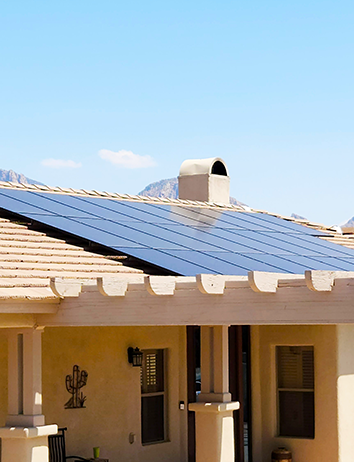
Solar proposals describe system size in kilowatts, or kW. A larger system generally costs more overall. Price per watt helps you compare solar-only cash proposals of different sizes.
Divide the installed solar cash price by the system’s DC capacity in watts. Here is how that calculation works:
| System size | Example at $2.50/watt | Example at $3.00/watt |
|---|---|---|
| 6 kW | $15,000 | $18,000 |
| 8 kW | $20,000 | $24,000 |
| 10 kW | $25,000 | $30,000 |
| 12 kW | $30,000 | $36,000 |
Examples exclude batteries, roofing work, electrical upgrades, financing charges, and incentives. Your home requires an individual proposal.
Twelve months of electricity usage in kilowatt-hours is more useful than home square footage alone. Air conditioning, pool equipment, and electric vehicle charging can all change the system size that makes sense for you.
Your annual electricity use, future needs, and available roof space influence system size. More panels can produce more electricity, but the right design also considers when your home uses it.
Tile, shingle, and low-slope roofs can require different mounting approaches. Repairs, shading, complicated layouts, and access affect the work involved. Ask whether roofing work is quoted separately.
Compare exact equipment models, warranties, and monitoring features. Explore our solar panels and inverter options.
Some homes need electrical upgrades before solar or batteries can be connected. Your proposal should identify panel upgrades, service changes, trenching, and any other included work.
Battery capacity, power output, supported circuits, and backup controls all influence installed cost. Specify what you want to power during an outage before comparing prices.
Cash, financed purchases, and leases can have very different total costs. Compare the cash price, financed amount, fees, interest, and contract terms alongside the starting payment.
The system price is only part of the decision. Potential savings also depend on your utility rate plan, when your home uses electricity, and how much solar energy you send to the grid.
For new TEP solar customers, time-of-use pricing and the applicable Resource Comparison Proxy export credit are important parts of the calculation. Electricity used in your home and electricity exported to TEP should be modeled separately.
Generating as much electricity as you use over a year does not necessarily eliminate your utility bill. Ask for the remaining bill estimate alongside your solar payment.
Read TEP’s solar and rate guidanceCompare total household energy costs over the same period. Include any upfront purchase cost when evaluating long-term savings.
Battery pricing depends on more than the battery itself. Installed cost may include backup controls, electrical work, permits, and changes to the circuits it supports.
Ask for separate solar-only and solar-plus-battery proposals. Compare the additional cost with your goals for backup power and electricity use.
| Configuration | What to compare |
|---|---|
| Solar only | Installed price, projected production, and remaining utility bill. |
| Solar with selected-circuit backup | Battery capacity, supported circuits, expected runtime, and additional installed cost. |
| Solar with broader home backup | Required power output, number of batteries, supported appliances, and additional electrical work. |
If running air conditioning during an outage is a priority, request a design that specifically addresses that load. Storage capacity alone does not tell you which appliances can operate together or for how long.
Compare our solar battery options →Compare what you pay upfront, what you pay over time, who owns the equipment, and what happens if you sell your home.
| Option | Payment structure | What to review |
|---|---|---|
| Cash purchase | Upfront purchase price | Included work, warranties, and service responsibilities. |
| Financed purchase | Down payment, if any, plus loan payments | APR, fees, term, total payments, and payment changes. |
| Prepaid lease | Upfront payment under a lease agreement | Ownership, maintenance, transfer, purchase options, and end-of-term terms. |
| Monthly lease | Recurring lease payments | Escalator, total payments, service terms, and home-sale transfer requirements. |
A low starting payment does not tell you the full cost. Ask for the complete payment schedule and compare options using the same system design and utility assumptions.
The federal Residential Clean Energy Credit under Section 25D is not available for expenditures made after December 31, 2025. A new 2026 homeowner purchase should not include an automatic 30% federal homeowner credit.
Read current IRS guidanceArizona offers a nonrefundable individual credit for qualifying solar energy devices: 25% of qualifying cost, subject to a cumulative $1,000 limit per residence and eligibility requirements. It is not an automatic cash rebate.
Review Arizona Form 310Incentive information checked September 21, 2026.
A useful proposal makes the scope, cost, and assumptions easy to understand. Before choosing a system, make sure you can identify each of these items.
Desert Solar Energy is an independent solar dealer based in Tucson. We help homeowners compare available system and payment options. Your proposal should identify the installing contractor and clarify installation and service responsibilities.
Meet Desert Solar Energy →Square footage alone cannot determine cost. Two similarly sized homes may use very different amounts of electricity. Annual usage, roof layout, equipment choices, and battery needs provide a better starting point.
You should expect a remaining utility bill. Its amount depends on your rate plan, electricity purchases, export credits, and applicable charges. Review that estimate alongside any solar payment.
No. Price per watt is useful for similarly scoped solar-only cash proposals, but does not capture every difference in equipment, installation work, warranties, or service. Separate batteries and other extras before comparing.
Yes, solar-only designs are an option. Ask for both configurations if you want to compare upfront cost, projected utility costs, and backup capabilities. A typical grid-connected solar-only system does not supply backup power during an outage.
Some financing or lease options may offer no upfront payment to qualified applicants. That does not mean the system is free. Review fees, payment changes, total payments, and eligibility.
There is no single payback period for every Tucson home. A useful estimate needs the installed price, eligible incentives, projected utility savings, and ongoing costs. Financing and lease options require their own cash-flow comparisons.
Have its condition evaluated before installation. If major work is likely soon, ask how coordinating that work now compares with removing and reinstalling panels later.
Get a proposal based on your electricity usage, roof, and goals. Compare the installed price, payment options, and estimated remaining utility bill—with battery options if you want them.
Have a recent electric bill handy? It helps us understand your usage and compare options for your home.
CUSTOMER EXPERIENCES
Hear how Tom helps homeowners understand their solar options.
★★★★★
“Tom was the only one I could truly understand.”
★★★★★
“He made our decision to install solar informed and logical.”
★★★★★
“…answered every question I had without making me feel rushed or pressured.”


