TUCSON SOLAR NEWS
Can Solar Batteries Run Your Air Conditioner During a Tucson Power Outage?
A properly sized solar battery system can keep your air conditioner running during a Tucson power outage. This guide explains how to tell whether a battery can start your AC, what affects how long it can keep cooling your home, and when solar panels can recharge the battery while the grid is down. It also covers how to decide which appliances to back up and whether you might need more than one battery.
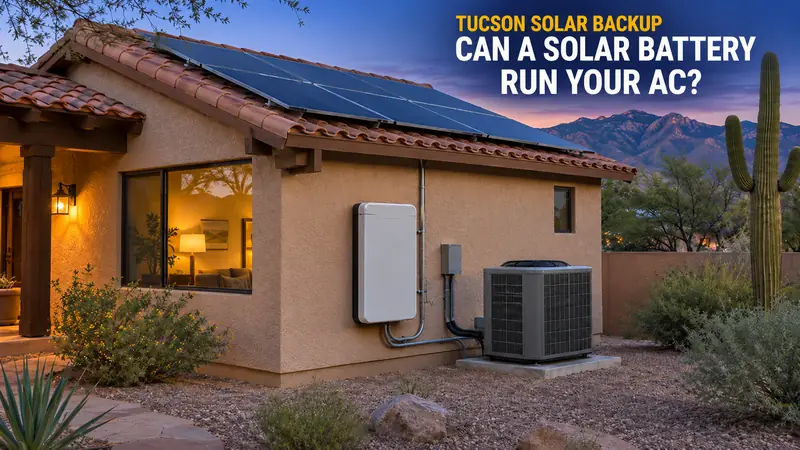
Can Solar Batteries Run Your Air Conditioner During a Tucson Power Outage?
Yes—a properly designed home battery system can run an air conditioner during a power outage. But whether it can power your particular AC, and for how long, depends on the equipment, the battery’s charge level, and what else is running in your home.
For Tucson homeowners, those details matter. Keeping the refrigerator and lights on is helpful, but maintaining a comfortable indoor temperature during a summer outage takes more planning.
Here’s what you should know before choosing a solar and battery system for your home.
Starting Your Air Conditioner and Keeping It Running Are Different Jobs
An air conditioner needs enough power to start its compressor, then a continuing supply of electricity to keep cooling your home.
Some compressors draw a brief surge of electricity when they start. A battery system must handle that surge while also supporting any other appliances operating at the same time.
That means a battery can have plenty of stored energy and still be unable to start a particular air conditioner if its power output is insufficient.
Two measurements help explain the difference:
- Kilowatts (kW) measure how much power the system can deliver at a given moment.
- Kilowatt-hours (kWh) measure how much energy it stores for use over time.
Think of power as the ability to operate your equipment and stored energy as the supply that determines how long it can operate.
The AC’s model, compressor starting requirements, running consumption, and indoor blower all need to be considered. Cooling capacity alone—such as whether your AC is a three-ton or five-ton unit—doesn’t provide the complete answer.
Can a Tesla Powerwall Run Central Air Conditioning?
A Tesla Powerwall 3 can support many central air-conditioning systems when the installation is designed for those loads.
Tesla lists 13.5 kWh of nominal battery energy and a motor-start capability of 185 locked-rotor amps for Powerwall 3. Compatibility still requires an assessment of your AC equipment, the system’s configured output, and the other loads it will supply. Tesla Powerwall 3 specifications
The important question is more specific than “Can a Powerwall run an AC?”
It is: Can this battery configuration start my air conditioner, support my other essential appliances, and provide the backup time I want?
How Long Can a Battery Run Your Air Conditioner?
There isn’t one reliable runtime estimate for every Tucson home.
Runtime depends on:
- How much stored energy is available when the outage begins.
- How much electricity your cooling system consumes.
- How often the compressor runs.
- The outdoor temperature and thermostat setting.
- Your home’s insulation, windows, shading, and air leakage.
- Other appliances drawing power.
- Whether solar panels are producing electricity during the outage.
A simple calculation can illustrate the relationship:
Available battery energy ÷ average household power demand = approximate runtime
For example, assume a system has 12 kWh available to supply household loads, with no solar production during the outage:
Average combined demand from AC and other loadsApproximate runtime3 kW4 hours4 kW3 hours6 kW2 hours
These are simplified examples, not predictions for a particular battery or home. They assume steady average demand and do not establish whether the battery can start the AC. Actual runtime also depends on operating limits, system losses, temperature, and equipment behavior.
An air conditioner that cycles off periodically may use less energy over an hour than one running continuously. During extreme heat, however, cooling demand may remain high for long periods.
That’s why a useful backup estimate should start with your actual equipment and energy usage.
Can Solar Panels Recharge the Battery During an Outage?
Yes, when the solar and battery system is configured to operate during a grid outage.
A compatible backup system can use daytime solar production to supply household loads and recharge the battery. After sunset, the home relies on the energy remaining in storage. Tesla describes this operation in its guidance on combining Powerwall with solar. How Powerwall works
However, sunshine doesn’t guarantee that the battery will recharge while the AC is running.
If your home uses all the electricity the panels produce, little or none remains for charging. If household demand exceeds solar production, the battery may continue discharging even during daylight.
Cloud cover, shading, season, and the size of your solar array also affect the available energy.
A system intended to support cooling through an extended outage needs an energy plan for both daytime and overnight operation.
Does Whole-Home Backup Mean Everything Can Run at Once?
Whole-home backup connects the battery system to support the home’s electrical loads, but the system still has power and energy limits.
Running central AC alongside an electric oven, clothes dryer, pool pump, and EV charger can place a substantial demand on storage.
Some homeowners choose to back up selected essential circuits. Others choose broader coverage with controls that manage large appliances during an outage.
If cooling is a priority, the backup design must include the equipment needed to operate the cooling system, including the outdoor unit, indoor blower, and controls.
The goal is to decide in advance which loads matter most and size the system around them.
Will You Need More Than One Battery?
One battery may be appropriate for some homes and backup goals. Other homes may need additional storage, additional power output, or both.
Multiple AC systems, high overnight cooling demand, and longer desired backup periods can increase the system requirements.
It is also important to distinguish between adding stored energy and adding power output. Depending on the product, an expansion battery may increase runtime without increasing the system’s ability to start or operate additional appliances.
A good proposal should explain what each added unit contributes and how that supports your goals.
How Can You Make Backup Power Last Longer?
During an outage, reducing unnecessary electricity use leaves more energy available for cooling and essential appliances.
Practical steps include closing blinds on sun-exposed windows, keeping exterior doors closed, and postponing EV charging, laundry, and other large electrical loads.
Your battery settings matter, too. A backup reserve preserves a portion of stored energy for an outage. Keeping a higher reserve generally means more energy is available if the grid goes down, while leaving less for everyday energy management.
Tesla recommends reducing the use of energy-intensive appliances to extend backup duration. Your installer can help you develop an outage plan that balances cooling needs with available storage. Tesla guidance for power outages
What Should a Tucson Homeowner Ask Before Buying?
Before choosing a battery system, ask your solar professional:
- Can this configuration start and run my specific air conditioner?
- Which cooling components and household circuits will receive backup power?
- What runtime do you estimate for a hot summer evening, and what assumptions support it?
- What happens if the outage begins when the battery is only partly charged?
- Can my solar panels operate and recharge storage during an outage?
- Which appliances should be managed or switched off?
- Would additional batteries increase runtime, power output, or both?
Clear answers help you compare proposals based on the backup performance you actually need.
Find Out What a Battery Could Power in Your Home
Solar batteries can provide air-conditioning backup for Tucson homes, but the right system starts with your cooling equipment, energy use, and priorities.
At Desert Solar Energy, Tom and Tommy can help you explore solar and battery options and understand what a proposed system is designed to support.
Want to know whether a battery could keep your AC running during an outage? Request a personalized consultation or call 520-477-7031.